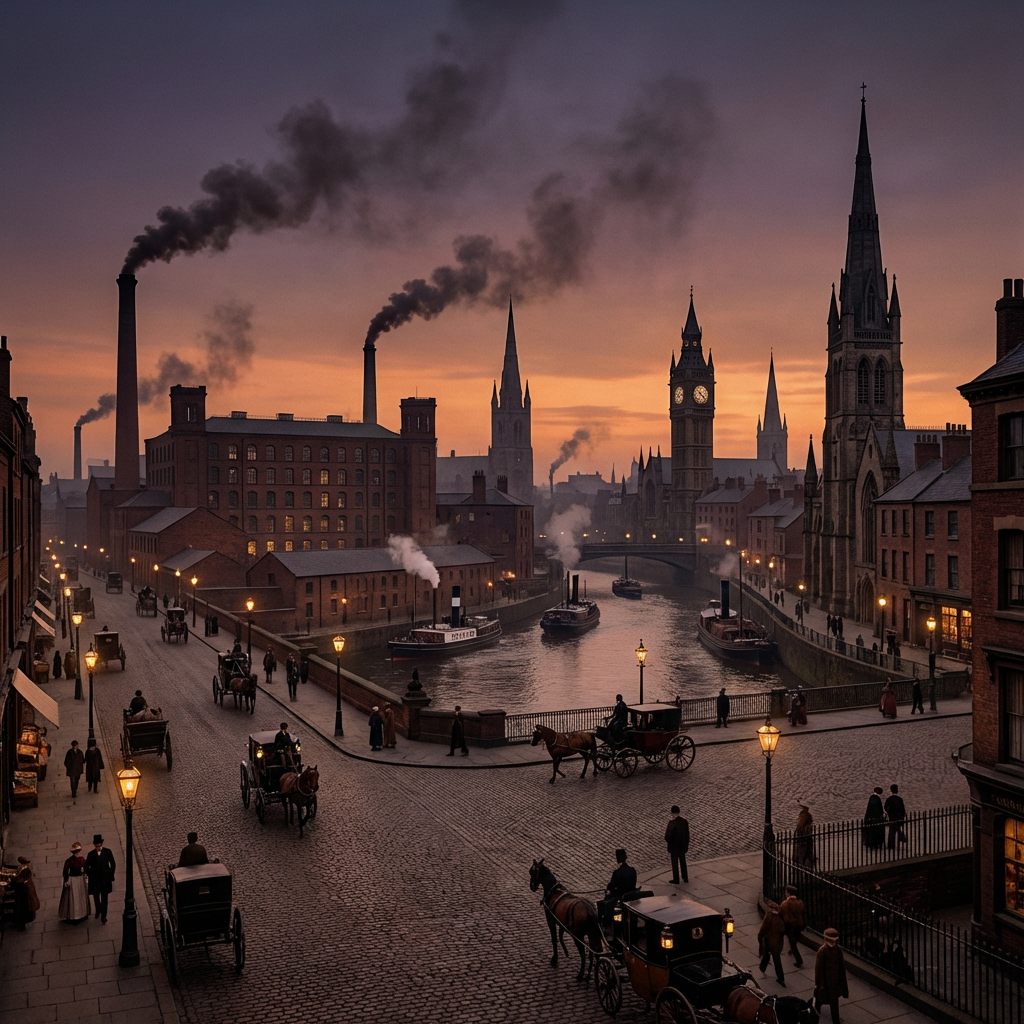
The Victorian Age represented progress to much of the Western world. With a burgeoning industrial base in Europe and North America, alongside flourishing developments in health, science, and religion, the Victorian era was the precursor to the Modern belief in empirical evidence. This shift paved the way for a more progressive, educated aristocracy that redefined the historical scope of the modern world. Labels such as “Lady” and “Gentleman” were bestowed upon the educated—the individuals tasked with continuing Western progress. Building on the philosophies of Hobbes, Locke, and Hume, the Victorian Age placed increasing value on the empirical; from this arose a greater divide regarding who was permitted to write, create, and speak “history” into existence.
It was during this time, when science and empirical reasoning ruled both the present and the interpretations of the past, that Scottish author George MacDonald penned volumes of fiction, fantasy, and fairy tales built upon an alternative epistemological understanding. This unconventional perspective emerged from the tension between MacDonald’s Calvinistic upbringing and his youthful engrossment with the Romantics. These two polarities were neither completely accepted nor rejected by MacDonald; instead, they led to his robust belief that meaning originates in metaphor. In her book, The Story, the Teller, and the Audience in George MacDonald’s Fiction, Rebecca Thomas Ankeny explains how these two dichotomies met:
“George MacDonald incorporates into his fiction his thinking [on] language and literature and the interdependent roles of author, reader, and text. These ideas… derive from the twin sources of Christianity and Romanticism and are essentially an investigation into symbolism. The logical basis for a symbolic view of language, artistic expression, or the universe is theistic, and, for MacDonald, Christocentric.”
MacDonald’s view of history adheres more closely to a postmodern narrative influenced by Christian faith than to the empirical views of reason dominant in the Victorian Age. This perspective is evident when examining MacDonald’s faith, his literary influences, and ultimately his use of symbolism in his stories.
MacDonald’s Christian faith grew from his Scottish Calvinist roots. Although he ultimately rejected certain aspects of this tradition, his early exposure was foundational to his religious beliefs and shaped much of his later writing. As C.S. Lewis once said of MacDonald’s theological background, “all his life he continued to love the rock whence he had been hewn.” Even G.K. Chesterton, who was critical of Scottish Calvinism, conceded that MacDonald’s writing contained “a sort of optimist Calvinism.”
From these Calvinistic roots, MacDonald drew an emphasis on personal holiness and the sovereignty of God. This teaching of God’s total power formed the foundation for other Calvinistic tenets such as Predestination and Election. These doctrines were repeatedly taught to him from an early age through the Westminster Shorter Catechism, a religious methodology of sorts. MacDonald’s later reaction to this methodology revealed a profound distaste for the arrogance and piety that often accompanied the attempt to “uncover” all the great mysteries of faith. He was dissatisfied with the belief that a sovereign God could be contained within a creed or a list of bulleted beliefs. For MacDonald, truth and faith were an intricate fabric woven together by reason and imagination; to unravel the knots would be to destroy the entire tapestry.
During the later years of his education at King’s College, MacDonald was confronted with numerous theological dilemmas, struggling sincerely with the doctrine of everlasting punishment. It was during this time that he found clarity through the works of Romantics such as Coleridge, Wordsworth, and Novalis. From that point forward, MacDonald began forming a unique syncretic union between Romanticism and Christianity. Through this union, MacDonald identified history as a subjective understanding of symbols and metaphors used for personal growth in faith and righteousness.
MacDonald’s Christianity and writing were greatly influenced by Romanticism, a legacy that carried over into modern fiction. In her introduction to The George MacDonald Treasury, Madeleine L’Engle writes, “Surely George MacDonald is the grandfather of us all—all of us who struggle to come to terms with truth through imagination.” L’Engle attributes her own imaginative success to MacDonald’s struggles. Much of the imagination L’Engle admires stemmed from MacDonald’s reading of Samuel Taylor Coleridge and the early German Romantic author Georg Philipp Friedrich Freiherr von Hardenberg (better known by his pen name, Novalis).
Both men directly affected how MacDonald perceived truth. Coleridge’s philosophy of Idealism—the assertion that objects of perception consist of ideas—was paramount in shaping MacDonald’s fiction. This Idealism created a more organic, free-flowing understanding of truth than the Shorter Catechism provided years earlier. This new system of ideas worked within a universal polarity that oscillated between visible life and the invisible forces that sustain it—the seen flower and the unseen seed. An excerpt from Paul Faber, Surgeon, one of MacDonald’s adult novels, illustrates this mingling of truths: MacDonald explains that music possesses the truth of “the relation of sounds and of intervals” and its relation to the creativity of the producer. Not only this, but he suggests that “the something it gives birth to in the human mind is also a true thing.”

 The Wise Imagination
Leave a reply to Home And Spirit Cancel reply