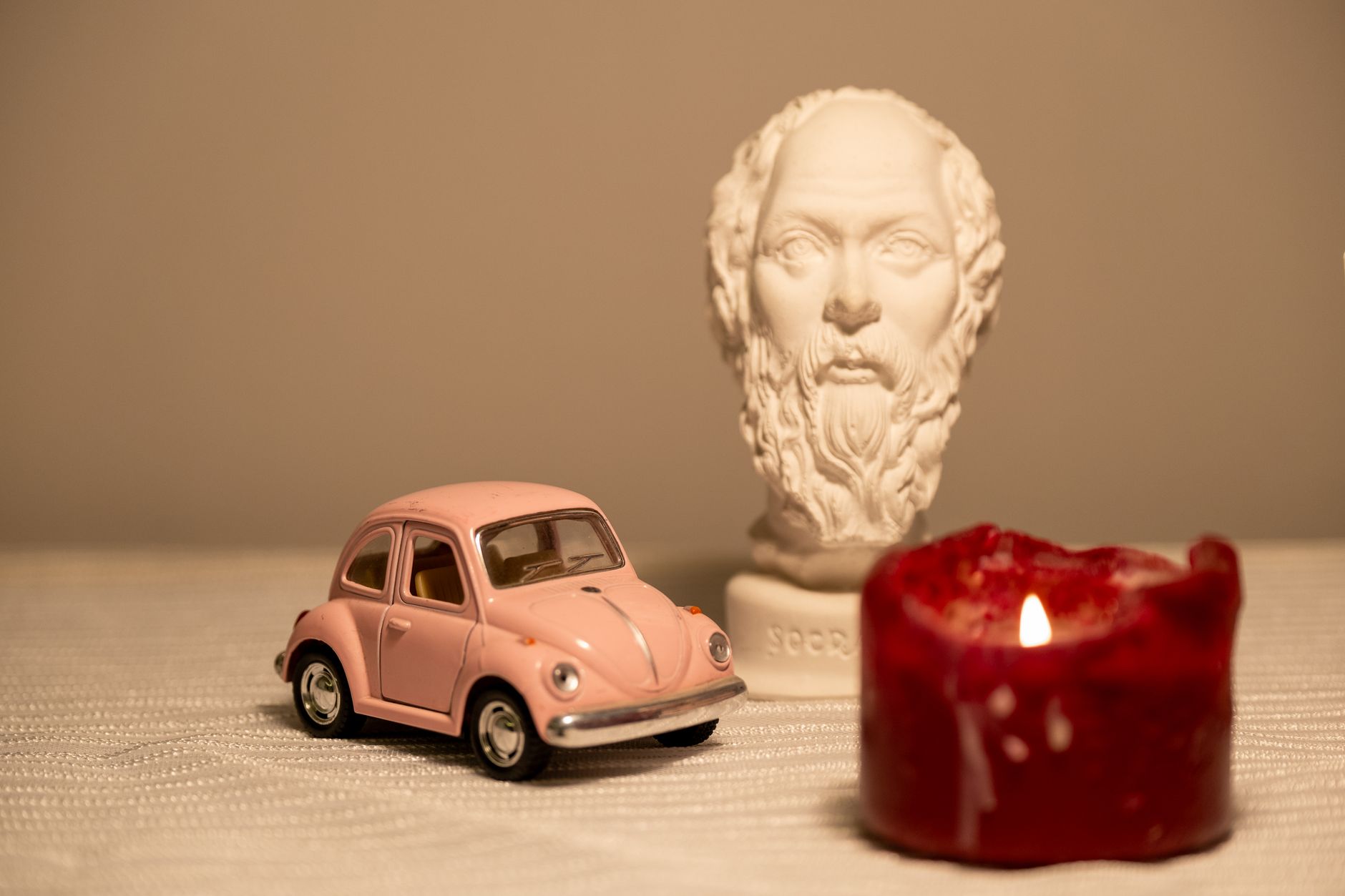
I use the word “education” all the time. I hand out novels. I help students use a semicolon correctly (and then limit their use of the semicolon). I teach the structure of a synthesis essay, mark the essay with feedback, and talk to my students about that feedback and how they learn from their mistakes (one of which is using too many semicolons). Report cards, fire drills, and parent-teacher conferences are all part of what I mean by “education,” but is that what the word really means? Is education just another structure, another list, or another paradigm to somehow convince teenagers that Animal Farm is a kick-butt book? We all know that all strategies for learning are equal, but some strategies are more equal than others. I think there is much more to education than just the propoganda of learning.
Plato used a word for education: paideia. We usually translate it as “education” or “upbringing,” but both translations lose the size of what Plato was trying to communicate. Paideia is the formation of a whole person, and that includes what you love, what you shy away from, and what you reach for when nobody is watching. To Plato, all of this is “education,” and the loves come first.
Learning to like the right things, early
In Book II of the Laws, Plato’s Athenian stranger defines education. A child’s first sensations are pleasure and pain, he says, and education begins there, in learning to feel those two things in the right places: to take delight in what deserves delight and to be pained by what should pain you. All of this happens long before the child can explain why, or give you reasons, or write the paragraph.
If we take this seriously, then school changes shape a little. The songs a class sings, the stories it hears, the things a teacher laughs at and the things a teacher becomes upset over, these are doing educational work whether we planned them or not. In the Republic, Plato repeats these worries. The tales told to the young mould the soul, he argues in Books II and III, and they mould it more deeply than almost anything that comes later.
The cave, and the slow work of turning around
Then there is the cave, in Book VII of the Republic. Prisoners chained since childhood, watching shadows on a wall and believing that the shadows are all there is in the world. One prisoner is freed, turned around, dragged up into daylight. But his eyes hurt. He would rather go back to the shadows because at least he was comfortable in the cave and knew how to name all of the shadows.
Plato (through the lips of Socrates) pauses the story to make a distinction that the whole story hangs on. Education, he says, is not putting sight into blind eyes. Some people talk as if knowledge could be poured into a soul that lacks it, the way you would fill an empty container. Instead, what a person needs is to be turned, the whole soul together, away from the shadows and toward what is real. The Greek word he uses is periagoge: a turning around. That turning is why periagoge is often translated in Latin as conversio, which is where we get the word “conversion.”
I find all of this both encouraging and mildly terrifying as a teacher. Encouraging, because my students are not empty containers and never were. Terrifying, because turning is slow work, and it cannot really be done to somebody who doesn’t really want to be turned around in the first place.
In the story, it also explains why the freed prisoner does not stay up in the sunshine enjoying himself but is compelled to go back down to try to free the other prisoners. Of course, those of you who know the story know that the other prisoners spurn and mock the freed prisoner and basically tell him that they will kill him if he doesn’t leave (basically one of my typical English 10 classes). In Plato’s opinion, an educated person owes the cave (or the prisoners) something because he didn’t just get “educated” for his own benefit.
Can character be trained?
We praise people for being brave, generous, honest, and we blame them for cruelty, for cowardice, or for cutting corners. We do it instinctively, at home and in classrooms, and we rarely stop to notice what the praising and blaming assumes. It assumes the person could have been formed otherwise. Nobody praises a student for being tall, and nobody blames his neighbour for the weather. Praise and blame only make sense when they are aimed at something that can be shaped, practised, or trained.
This means virtue, according to Plato, sits within the trainable category. His whole scheme in the Laws, the careful early training of pleasure and pain, the songs and stories chosen on purpose, only works if what a child delights in can be taught to change. Character is not a graduation gift you are given after high school. It is closer to a direction a soul has been turned in, gradually, by a thousand small approvals and disapprovals along the way. Anyone who has watched a student slowly become kinder throughout the school year, and wondered whether anything they did had anything to do with it, is asking Plato’s question. Plato (at least in the Laws) would say yes, because that is “education.”
Standing next to Aristotle
If you have been reading the Aristotle posts on this blog, some of this will feel familiar, and it should. Aristotle was Plato’s student for twenty years. The resemblance is not an accident.
When I wrote about Book II of the Nicomachean Ethics, on how we become good, the headline was about habit. We become just by doing just acts, brave by doing brave ones, because virtue is practised long before it feels natural. Plato’s training of pleasure and pain is that same insight at an earlier age.
Book III brought in choice, and with it praise and blame. Aristotle argues that we hold people responsible for actions that are up to them, and that character itself falls partly into that category because the habits that built it were chosen one act at a time. Set that beside Plato, and they are describing one road from two places along it. Plato stands near the beginning, watching a soul get turned, while Aristotle walks further down and maps how the turning works itself out, act by act, choice by choice. They do disagree elsewhere, most famously over Plato’s Form of the Good, which Aristotle rejects in Book I (I.6), but on how a person gets formed, they are walking the same road.
Aristotle asks how a good person is made. Plato asks which direction the soul is currently facing, and who or what is doing the turning. Every classroom answers that second question daily. The stories on the syllabus answer it. So does the stuff students scroll at midnight, if we are honest.
None of this has made my marking pile smaller, sadly, but it has changed what I think the pile is for. The essays are evidence, most weeks, of which way a young soul is learning to turn, and whether the things he or she is learning to love deserve to be loved. That is a slower and much stranger job than delivering a lecture on Hamlet. It is also, I am coming to think, the actual one.
I am still turning, then. Them, and me with them.
Passages behind this post: Plato, Laws II, 653a–c (pleasure, pain, and right reason); Republic II–III (the tales that mould the soul); Republic VII, 514a–520a, especially 518c–d (the cave and periagoge, the turning of the whole soul). Aristotle, Nicomachean Ethics II (virtue formed by habit) and III (choice, praise, and blame).
Leave a Reply