“For by him all things were created, in heaven and on earth, visible and invisible… all things were created through him and for him. And he is before all things, and in him all things hold together.” — Colossians 1:16-17
Lately, I have been convicted of a quiet failure: I have stopped practicing the discipline of looking for beauty.
I have fallen victim to the “tyranny of the urgent”—that modern pestilence that drains our energy under the guise of “getting things done.” This isn’t the productive fatigue of a well-prioritized list; it is the antithesis of forethought. It is living moment-to-moment without context, performing actions without understanding their purpose. It is like walking head-down through a dark tunnel, unaware that the light at the end is the very reason we are moving.
This way of living anesthetizes our ability to see. We devolve into “creatures of task,” like oxen driven hard in a field, never pausing to enjoy the harvest.
The Divine Mirror: Nature and the Human Hand
I do not believe we were designed to live this way. As Colossians reminds us, all things are held together by God and created for His glory. When we look into creation, we are looking into an aspect of the Creator Himself.
There is, however, a second kind of beauty—one that comes from the human hand. In her brilliant work The Mind of the Maker, Dorothy L. Sayers argues that our desire to create is the primary way we reflect the Imago Dei (the Image of God). She notes that before Genesis describes man’s soul or his reason, it simply describes God as a Creator. Therefore, the characteristic we most fundamentally share with God is the desire and ability to make things.
While we are not divine, we carry a divine “imprint.” As G.K. Chesterton famously pointed out, an animal may build a nest or a burrow, but only a human aspires to architecture. Art is our way of mimicking our Creator—like a child grabbing a plastic hammer to “help” his father build a treehouse.
The Thirst for Union
Seeing this beauty does not come naturally in a world of noise; it must be cultivated. We have a deep, ancestral hunger to be connected to beauty, yet we rarely have the discipline to experience it. C.S. Lewis captured this ache perfectly:
“We do not want merely to see beauty… we want something else which can hardly be put into words—to be united with the beauty we see, to pass into it, to receive it into ourselves, to bathe in it, to become part of it.”
A Liturgy of Beauty: How to “Bathe”
To lift my head from the darkness of the “urgent” tunnel and refocus on the light, I have begun practicing a few specific activities. These are not tasks to be checked off, but disciplines to be savored:
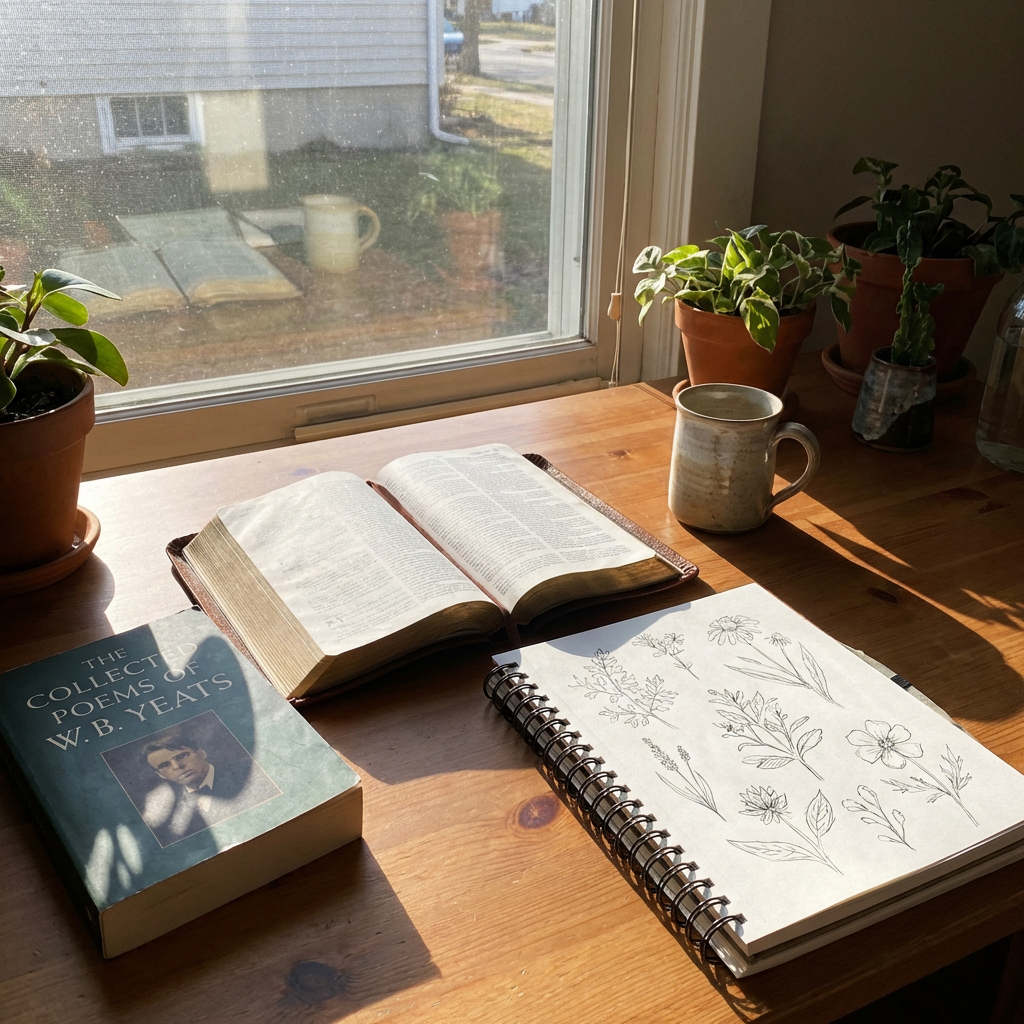
- Study the Bible: Move beyond the “devotional” and into the deep architecture of the Word.
- Read Poetry: Struggle with it until the meaning unfolds.
- Listen to the Elderly: Ask for their “eyes” on the world.
- Interrogate Children: Notice the unfiltered wonder in how they see.
- Active Listening: Listen to music without doing a single other thing.
- Physical Ascent: Climb a mountain for the perspective only height can give.
- The Silent Sketch: Draw the details of an object, even if the result is “horrible.” The act of drawing forces the act of seeing.
- Pray and Pause: Speak to God, and then stay silent long enough to listen.
This is a rudimentary list, a starting point for reclaiming the “privilege of individuality” that Lewis spoke of. It is a way to stop being an ox and start being a co-creator.


Leave a Reply